The Trials and Tribulations of a Family Business

If you ever find yourself being invited to participate in a family business, my advice is to think twice. This holds true whether the invitation comes from your own kin or a loved one, such as a partner or significant other. This is particularly pertinent when it comes to the food and beverage industry.

For the past four months, I’ve been assisting my partner with his new venture. His decision to enter the restaurant industry at this stage of his life remains a mystery to me. Despite my two decades of experience in various types of restaurants, my advice to steer clear of this business model fell on deaf ears. As the saying goes, some people need to learn their lessons the hard way. Despite my reservations about the business, my love for my partner compelled me to lend a hand.

I brought a wealth of experience to the table. While I didn’t have all the answers to opening a restaurant, I certainly knew more than my partner and his family. Fast forward a few months, and I found myself gracefully stepping back. My academic commitments were a factor, but not the primary reason for my departure.

Menu items which my partner and I had discussed, items I knew that if we’d sell would do amazingly well, were quickly considered by the others and discarded. Conversations of plans as to how to move forward with certain goals would change within seconds without my knowledge of it, at times creating a double workload for me, having to do and redo projects. My role of interviewing and hiring was diminished to really only calling and speaking to those who couldn’t speak English. That’s when my experience was really needed, to interpret.

Being part of a family business where you don’t share the family name can be challenging. Regardless of your experience, there will always be those who believe that age or a certain background gives them the upper hand. I often felt that my ideas were entertained but never seriously considered, which was frustrating. The final straw came when we hired a professional chef, and even her qualifications were questioned.

Given my personality, it was difficult for me to hold my tongue, and I realized I had to leave. I couldn’t risk damaging my relationship with my partner or his family. Integrating into his family had already been a challenge, and the added stress of the business was the last thing I needed.

Life is short, and our purpose is to enjoy ourselves. When something ceases to be enjoyable or exciting, it’s a sign that it’s time to move on. I’ve learned to trust that instinct and not waste time, as it usually prevails. So, I sent an email requesting to be relieved of my management responsibilities. I drew a line in the sand and set a boundary. It was a liberating experience, but the lack of response to my email was disheartening. I felt as though my hard work and dedication over the past four months had been in vain.

I was left with a nagging pain in my neck from stress and a heavy heart. I realized that my partner had not made a better effort to involve me more in the business. It felt as though I was on a team that I hadn’t been recruited for. It was akin to letting the little sister play, but her position doesn’t count.

My next step is to avoid getting drawn into their queries. I’ve stepped away, and they need to figure things out. I wish them the best, and while it’s unfortunate that this wasn’t the joint project I had envisioned for my partner and me, that’s okay. I’m proud of myself for not falling into old patterns and for taking control of a potentially stressful situation. Now, it’s time for me to move on and enjoy the summer.


Linwood Country C&$*@

After a grueling work week, my best friend and I sought an outdoor haven to unwind on our cherished Friday afternoon. We she discovered a charming spot in a nearby town, boasting picturesque outdoor seating and the promise of live music that evening. The venue was a local country club, a place I had visited once before, two years ago, when their outdoor section was just blossoming. Apart from the captivating scenery, there wasn’t much happening then, so I hadn’t returned until now.

Fast forward two years, my best friend and I, eager for a change of scenery and a good catch-up, arrived at the club. Initially, it was serene, with only a handful of golfers dotting the landscape. The bartenders were in a state of calm preparation for the evening. However, as the sun began its descent, the place started filling up. We were probably the youngest patrons there, but we didn’t mind, as we usually prefer the company of an older crowd. It soon became apparent, though, that we had intruded on the territory of the bar’s regulars, who were none too pleased with two random strangers sitting at their bar.

The hostility was almost instantaneous: nudges, pushes, shoves. The first offender was the so-called “owner,” a term he liberally used. Unbeknownst to him, I was aware of his actual status as a silent partner, a term he seemed to misunderstand. His behavior was boorish, treating the bartenders and paying customers with condescension. The air was thick with entitlement, hanging over the crowd like L.A city smog.

As we dealt with the “owner,” I began to notice out of my peripheral a woman began buzzing around me like an irksome mosquito. Suddenly, she was right next to me, her sweaty arm uncomfortably rubbing up against mine, and she started bombarding me with questions, “Who are you? Where you girls from, locals? What are you doing here? Are you leaving soon?” When she realized I wasn’t giving her much attention, she resorted to insults (per what foolish people do when they aren’t getting what they want), loudly proclaiming that the men at the bar weren’t “my type.” I asked her to clarify, and she suggested that the men were too old for me and that I should look elsewhere. Her audacity was cringe-worthy. Not for me but for herself for this sad woman was someone’s something.

You could begin to feel the crowd’s energy began to shift, some siding with her, while a few sympathized with us. Those who felt bad tried to make amends by offering to buy us drinks, which we declined. The husband of the pesky mosquito came over to apologize and then also stated,

“Trust me, if I could divorce her without her taking half of everything, I would have done it a long time ago. She is horrible.”

Our intended relaxing day off had turned into a battle of wills. To add to the ordeal, our quesadilla order, placed an hour and a half earlier, had yet to arrive. The bartender, sensing our discomfort, assured us that our food would be out soon. When it finally arrived, we quickly finished, paid, and left, but not without a lingering feeling of defeat.

I wrote a review, expressing my disappointment with the “owner’s” behavior and the regulars’ unwelcoming attitude. Sure, while customers come with their own set of quirks, can’t say much to that, it’s definitely within bounds to nudge the “owner” about minding his manners around the staff and patrons. If I were the boss and caught a glimpse of an owner acting out, I’d be more than just a little shocked – I’d be ready to teach a masterclass in Business Etiquette 101!

In my review, I vowed we’d be back, not keen on allowing them to treat us as the outsiders. Yet, in the days that followed, I had my doubts. It was a bit of a bummer to imagine those laughing hyenas carrying on with their night as we trudged home, spirits low. For them, it was just a blip on the radar, probably the butt of jokes as their evening rolled on. For us? It was a gloomy cloud that hung around way longer than welcome.

It’s quite the paradox, isn’t it? There we were, a couple of peace-loving souls, just trying to unwind, and yet we found ourselves in a stress-inducing saga. It’s ironic how we all aimed to chill out, but some folks must’ve missed the memo. The instigators likely slept like babies, oblivious to the chaos in their wake.

To them, we were merely obstacles in their quest for an extra squeeze of lemon in their vodka water.

Monday Morning Coffee

Isn’t it wild how the simplest of morning rituals, like brewing a cup of joe, can catapult you on a time-traveling adventure back to the days of yore? That’s exactly what happened to me this morning. As I savored the first few sips of my meticulously brewed French press coffee made with fresh ground coffee beans (from the mountains of Colombia!), a thought struck me – this doesn’t hold a candle to mom’s coffee!

Now, here’s the kicker. My mom, a superhero in disguise, single-handedly raised two kids while juggling three jobs. She didn’t have the luxury of buying coffee beans, let alone have the time for a grinder followed by simmering in a French press. Her magic potion? Instant coffee! A generous scoop from the big red plastic tub, a splash of boiling water, a quick stir, and voila! A steaming cup of black coffee, as is the custom for most Colombians.

While Cubans have their petite espressos, Colombians relish their ‘tinto’ – small shots of black coffee. But the coffee that had me reminiscing wasn’t her usual black brew. It was something special, something she made when she could steal a few extra moments.

She’d heat milk until it was frothy and fluffy, the likes of which I’ve never seen replicated on a stovetop. This creamy delight was then added to the coffee, creating a sort of ‘cafe con leche’. That was the coffee that had me lost in nostalgia this morning.

The memory was a bittersweet symphony, filling me with joy and a pang of sadness. Why the sadness, you ask? Because I know I’ll never taste that coffee again. Sure, my mom’s still around, but she’s traded her instant coffee for a more leisurely brew. I could try to recreate her masterpiece, buying the same ingredients, following the same steps that I’ve watched her do countless times. But deep down, I know it just wouldn’t be the same.

Isn’t life peculiar? The memories that fill us with the most joy often carry a tinge of sadness, simply because they’re experiences we can’t physically relive. But hey, that’s the beauty of nostalgia, isn’t it?

I’ve Only Got Two: Turning the Other Cheek

When you consistently display a forgiving and forgetful attitude, you unintentionally condition those around you to treat you as they see fit. This behavior reinforces the idea that their actions towards you, whether positive or negative, are acceptable and justified. By constantly turning the other cheek, you essentially signal to the world that it is acceptable to repeatedly mistreat you.

However, there may come a time when you no longer wish to maintain this passive stance. Eventually, you may become tired and decide to take proactive steps to protect yourself. This change in behavior can confuse and upset those who have become used to your constant tolerance. They may find it difficult to understand why you are suddenly showing assertiveness and inflexibility, and why you are no longer as understanding or willing to forgive and forget.

Eventually, you may reach a point where you firmly state that you will no longer tolerate such treatment. While some people may choose to abruptly end the relationship at this point, a more thoughtful approach involves introspection to identify how one’s own actions may have contributed to the development of such attitudes.

In recent years, since returning home, I’ve been forgiving and forgetting a bit too much. When you reach a certain stage in life, you start to evaluate what’s happening around you, and you gradually start to weigh what truly matters to you and what doesn’t. You begin to want to let go of things, conserving your energy for the things that truly matter to you. I stopped arguing and fighting over minor issues. In my view, if it won’t matter in a year, then why argue about it now? So, with this approach, I started to overlook the small lies of omission, or even the larger, more premeditated ones. I constantly put myself in others’ shoes, accepting their reasoning for what I felt could be interpreted as disloyalty, selfishness, and sometimes even scheming. I simply allowed others to be themselves, and if I discovered something unpleasant about them, I ignored it.

Now, those very same people are unable to do the same. They cannot set aside their own beliefs for others. They won’t sacrifice their own truth to allow someone else theirs. The level of entitlement, the level of selfishness, after much conditioning, is just too high.

In life, it is crucial to live your truth. Not everyone you make sacrifices for will be willing to do the same. Not everyone you help will be grateful. Not everyone you know, regardless of how long you’ve known them, will you be able to rely on, let alone trust. For many, this life is a game and in order for them to progress, they feel they must do so selfishly and unforgivingly. Fortunately for me, I understand that it’s not a game. We’re here for the experience and we can choose what that experience can be. I decided that I want to have fun and do things that make me happy. I want to follow what’s good and what feels good. Sometimes that means eliminating things that don’t serve me or my happiness. There will be tough decisions to make, but are they really that tough when you know that one decision will bring you joy and the other…won’t? For me, the choice is quite straightforward.

Spoken Truth: A Different Spotlight

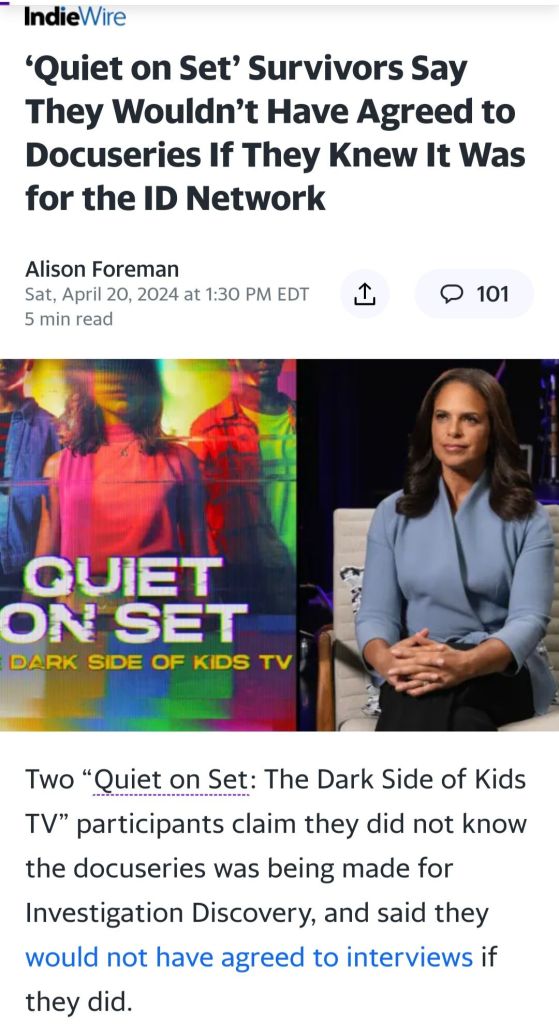
Like many others, I tuned in to “Quiet on Set,”, which revealed the hidden abuse of child stars behind the scenes. This series, particularly resonant with those of us who grew up in the ’90s, prompted a profound reevaluation of the shows from our youth. The recent revelations about “America’s Dad” and other beloved public figures have been shocking, exposing them as predators and casting a shadow over our entertainment icons.

The realization that numerous adults were present during those times yet remained silent—or worse, silenced those who spoke out—is staggering. The documentary was an eye-opener for me.

However, this morning, an article caught my attention. It discussed the discontent among some cast members of “Quiet on Set” regarding the lack of communication about the series airing on ID Network. A few are now expressing regret, stating that had they known it would be aired on ID, they would have declined to participate. They worry that their stories, and the gravity of the issues they raise, may not be receiving the serious consideration they warrant.

I’m perplexed by the weight given to the network broadcasting our stories. Whether it’s the investigative lens of “2020” or the crime-focused gaze of Investigation Discovery, isn’t the essence that the narrative is conveyed with fidelity? If the harrowing journeys and the shadows of abuse endured by the victims are brought to light, why does the channel of delivery stir such debate? For the regular ID audience, who are connoisseurs of crime and inquiry, the platform should not dilute the potency of the message, but rather serve as a conduit for the voices that demand to be heard.

To quote Alexa Nikola, she states:

“We have to live with our stories and how they were treated by ID and Maxine forever while they see it as leverage for future projects…. There’s nothing bingeable about trauma.”

Yet, my perspective diverges. In the tapestry of today’s society, it is the threads of sensationalism, horror, and trauma that enthrall the masses. This voracious appetite for the macabre is what dominates the zeitgeist. It’s a melancholic reflection that the integrity of these stories may be under scrutiny, doubted perhaps by viewers, or even the very individuals who bared their souls. It’s the underlying dread that their confessions might be dismissed. However, contrary to their fears, the world has indeed taken notice.

As the final credits of “Quiet on Set” roll, the echoes of the revelations linger in the minds of viewers. The series, a tapestry woven with threads of courage and vulnerability, leaves an indelible mark on the collective memory of a generation. It stands as a testament to the resilience of those who endured, and a call to action for an industry in dire need of reform. While the platform of its unveiling—ID Network—may be debated, the imperative message it conveys transcends boundaries, urging us to listen more intently and advocate more fiercely for the silent voices that have only just begun to speak.

The Quiet Reckoning

“Daddy! I need help!”

A cry pierced the air, a symphony of irritation and mild alarm; it heralded no menace, only the onset of a deluge of tears that dared to breach the ramparts of my heart, long fortified. There, in her vibrant fuchsia chariot, the little girl and her companion sat, teetering on the edge of too-grown for such whimsical rides. Midway through their suburban odyssey, the spirited steed faltered, its electric lifeblood drained, leaving dreams momentarily stranded.


“DADDYYYYYYY!” He was still inside, and these young ladies had a block to drive.


Suddenly he bolts out of the house as if he had been catapulted but some unseen force, hops down the four small steps, landing on the sidewalk with a WAP! Within seconds he makes his way down the sidewalk and around the back of the Jeep. Grabbing onto the back, he begins to run, pushing them down the sidewalk and sending them all into laughter.


This is the moment that I burst into tears.


It dawned on me then, the stark realization that the bond I yearned for with my father was a dream unfulfilled, now lost to time. A year and a half had passed since his departure. His health had always been fragile, leading to numerous scares, but our estrangement made these moments less poignant. In truth, he had been absent from my life; thus, his passing did not leave a void.
On the day of his passing, my tears were not for the loss of a beloved father, for our love had never blossomed. Instead, I felt a peculiar sense of curiosity. Visiting him a week before, I saw a man unknown to me. He lay silent, eyes closed, hands twisted in pain or discomfort, his mouth agape. Caretakers attended to him, wiping away drool, moistening his lips, offering water through a sponge.


A solitary encounter with him became memorable when I played a song from my childhood from the movie, “An American Tale,” which we cherished. His reaction was unexpected—his face contorted, tears flowed, and he emitted sounds of deep distress.


Before me was a stranger, a man whose life had barely brushed against mine. I didn’t know his favorite color. I did not know his favorite food. I didn’t know what genre of movie he preferred. I knew little of him—his likes, dislikes, or passions—save for his love of music and women. Whether his feelings for us were born of love or guilt, I could not discern.


I’m not going to say that he never tried, but there were certain wounds too deep, etched onto the soul of my being that wouldn’t allow for that to fully happen. There were rare occasions in which I had been the one to try. I’d reach out to him with a plan of action. We’d talk for hours going over what our lives had been up to that point and sprinkling in how we had to try to fix it, this, us. We’d hang up the phone, I’d feel light, and accomplished. That bit of motivation would then be followed up with silence. He would disappear and we wouldn’t speak for what would be for a couple of years after that. This would be our pattern until the day he died.


As a reader, I was aware of the potential regret of not connecting with him, a sentiment echoed by my family. Yet, now that he is gone, it is not regret that weighs on me but a profound disappointment—a longing to experience the sorrow that eludes me, the natural grief of a child for their father.


For months after he died, I would anxiously wait for the moment everyone had been warning me about. The moment of missing him, of yearning to hear his voice, or to hold his cold hands (his hands were always cold- “Cold hands, warm heart” he’d say!) but that moment never really came. I would try to sit in silence and see if I could feel his presence. I’d try my hardest to pay close attention to my dreams to see if maybe he’d visit me there. I soon realized I was reverting to childhood, always waiting for him, wanting him to visit, always being met with disappointment. So, I gave up again like I had years back.


Perhaps I won’t grieve as I did upon witnessing my neighbor, his offspring in tow, navigating a bubblegum-pink Barbie Jeep under the somber March skies. Yet, there’s solace in the breakthrough, a quiet epiphany embraced in solitude. It was a moment graced with a tender reflection of him, untainted by even a whisper of bitterness.

Tales of a Beachcomber’s Odyssey

Flipping through a kaleidoscope of snapshots, it’s like a whirlwind tour of the many ‘me’s I’ve been! From the zany outfits to the cast of quirky characters I’ve moonlighted as, it’s been quite the show. Take the beach life, for example. When you’re young, the beach is your stage, but it’s not all sunshine and seashells, especially if you’re flying solo. The local beach brigade? A motley crew of sun-toasted, merry-makers in their golden years, toasting to the good ol’ days with a never-ending happy hour. They’re living it up—or so it seems—riding the wave of yesteryears, chasing a mirage of ‘more’ that’s just a bit too far out of reach.

Ah, paradise—a solo gig can feel like a tropical time-out. Days blend into each other, an infinite loop of sand, sun, and the same ol’ sea. Sure, Florida was a blast with its endless summer vibe, but even paradise can get old. How, you ask? Well, imagine the same sunny script, day in, day out, even the palm trees start to look like party props after a while. At first, it’s an exotic escape worth every sacrifice. But give it time, and you start to wonder what you traded in for this beachy dream.

Then comes the moment of truth, drawing that line in the sand—literally. To stay or not to stay? That is the beachy question. It’s like the ocean’s own siren song, luring you back to its shores. I’ve packed my bags for Florida not once, but twice, and I’d be fibbing if I said a third encore isn’t tempting. But hey, if I’ve waved goodbye twice, there’s gotta be a reason, right? It’s the same back-and-forth with my hometown—how many farewells and reunions can one have?

Gazing at these piles of photos, the faces, the places, it’s clear there’s a whole world out there waiting for me to dive in. I’m jazzed about discovering my next grand scene. Until then, I’ll keep on trekking, little adventures at a time. Who knows? Maybe I’ll find my next ‘spotlight’ in the most unexpected place.

Monologues to Mute: Choosing When to Share and When to Spare

Letting someone peek into my personal diary is like spotting a shooting star – it’s special and doesn’t happen often, especially for a private person like me. But it’s no surprise when I get all steamed up because the person I’m sharing with turns the spotlight on themselves. Even more grating? It’s not their debut performance – we’ve been through this act more times than I can count, particularly with this family member. So, what’s the encore?

Maybe it’s time to close the diary.

The answer is as clear as a bell. If it only leads to a tug-of-war, then why bother opening up? Why even start such an intimate dialogue? I do it because the person I cherish is the one I desperately want to have an equal exchange with. A conversation where we both have the floor, taking turns in the spotlight. That’s not asking for the moon, is it?

Yet, it seems the limelight always finds them. Today’s lightbulb moment is about guarding my personal chapters. If someone is genuinely interested, they’ll inquire. If they don’t, then my rule is silence.

Followed, quite predictably, by absence.

I hold the reins, and sometimes I just need to remind myself of that.

The Ego’s Journey from Plasma Center to Bank Account

Why are we so obsessed with broadcasting our identity, like a peacock flaunting its feathers? So, I started trading plasma for plane tickets (cha-ching!), and I couldn’t help but notice the usual suspects shuffling in. There’s this itch, this compulsion to not blend into the crowd, even though I’m queuing up right alongside them. I may feel opposite, but in reality, I am no different from any one of them.

I was naive to the allure of ‘easy money’—it’s like catnip for the cash-strapped, the so-called outcasts of our oh-so-judgmental society. But really, how did that slip my mind?

The drill’s a breeze: strut in, sign up, and as long as you’re not a walking zombie or a protein-poor iron-deficient, you’re as good as gold! Ninety minutes and voilà—you’re a bit richer, and all it takes is a 48-hour breather before you can cash in again.

And here I am, a drop in the bucket of eclectic souls. We’re incognito yet bound by a secret pact: none of us are here for the noble act of donation. Nope, it’s all about the greenbacks.

I dish out one-liners, lock eyes with the staff, and put on my Sunday best (without making it obvious, of course). It feels like a charade, a confirmation of the ego lurking within us all. Despite our altruistic airs and empathetic hearts, we’re slaves to validation, seeking approval in the gaze and thoughts of others. For a rebel like me, who prides herself on shrugging off public opinion, it’s a bit of a bummer—a nudge reminding me that, deep down, I’m just another player in the game of life.

Echoes of Existence

“I wonder where my heart will land, and if it’ll land where my body lies.”- Natal Galvan

They are among us, yet they fade from my sight. No longer do I perceive the addicts; instead, I see the individuals they were, the selves they long to reclaim, the potential they possess. Their narratives are woven into their attire, their distress sculpted upon their visages. Occasionally, I discern the tears that mar their cheeks—tears ignored, for who casts a glance their way? What does it matter? Those tears are silent pleas for aid. Yet we don’t acknowledge their existence.

For some, their prospects were snatched away; for others, surrendered willingly. Their anticipated futures dissolved, leaving only the anguish of the present. Some occupy the desolate corners, chilled and damp; others wander the byways, seeking a path to renewal. Hope has eluded many, their strength waning. Among them are veterans who once battled for our freedoms, entrepreneurs who steered vast enterprises, individuals blessed with joyful beginnings, and those seemingly destined for relentless hardship.

If you pause to contemplate a moment in their lives, your soul cannot help but be burdened, for our imaginings pale in comparison to their stark realities. Thus, we must embrace compassion and empathy. Rather than averting our gaze, let us offer a simple smile—a beacon of hope to sustain them a moment longer.

They are all around us, invisible to some. But I see them—I see the humanity that endures within.