Don’t get me wrong, I know my “woofs.” As a dog sitter, I’ve learned that a bark is a language of its own. I can hear the difference between the “there’s a squirrel” yip and the “hey, I’m hungry” huff. But if you really want to know a dog’s soul? You have to listen to them sleep. While barks have character, snores have personality. In my time pet sitting, I’ve found that snores are the ultimate “tell.” They are unique, often hilarious, and frequently make zero sense compared to the dog they’re coming from. It’s a symphony of sleep that I’ve come to recognize better than any wagging tail or pointed ear.
The Great “Size vs. Sound” Mystery
The most entertaining part of my job is the “Identity Crisis” snore. You’d think a dog’s sleep sounds would match their stature, but in the canine world, the physics of sound work a little differently.
The Delicate Giant: I’ve looked after massive, “ferocious” barkers, dogs with a deep, chest-rattling boom that sounds like a thunderstorm. Yet, when they hit the pillow? They emit the daintiest, softest little skips of breath you’ve ever heard. It’s like a tiny bird trapped in a bear’s body.
The Pocket-Sized Powerhouse: Then there are the tiny ones. I once sat for a dog no bigger than a loaf of bread who managed to out-snore my significant other. It wasn’t just a sound; it was a rhythmic, house-shaking roar that defied the laws of biology.
The “Snoreshelf”: A Field Guide
Every dog brings their own unique “instrument” to the sleep orchestra. Here are the most common ones I’ve encountered:
| Snore Type | The Sound | The Vibe | | The Flutter-Leaf | A soft, rhythmic thrum-thrum of the lips. | Pure, unadulterated peace. |
| The Old Man Humbug | A series of low, grumbly sighs and nasal whistles. | Sounds like they’re complaining about the price of kibble in their dreams. |
| The Steam Engine | A heavy, chugging inhale followed by a dramatic “pfffft!” | Usually belongs to a dog who spent the day doing “big jobs” (like napping). |
| The Deflating Balloon | A high-pitched squeal that slowly fades out. | Hilarious, confusing, and totally endearing. |
Why the Noise Makes My Heart Melt
There is something so deeply rewarding about a dog snoring in your care. A bark is often a demand or a warning, but a snore? A snore is a compliment. It means they’ve reached that level of deep, heavy REM sleep where they feel completely safe. When the house is quiet and I hear those bizarre, mismatched, and sometimes confusing nasal melodies, I can’t help but smile. They aren’t just sleeping; they’re telling me they’re home. Barks might tell me what they want, but the snores tell me they’re happy.
When I dropped Ishka off at the groomer’s today, I found myself asking a very simple question: Why do some people wake up and choose unpleasantries? Like… is it a hobby? A lifestyle? A calling?
Our appointment was at 8 a.m.
I arrived at 8:04, which, in dog‑parent time, is basically early. I’m juggling my purse, my keys, and a very excited Ishka who is doing full‑body wiggles in my arms. I sprint up to the automatic doors… and they don’t open. Not even a pity shudder. Just a cold, silent “no.”
This is confusing because they also book 7 a.m. appointments, which implies that human beings should be inside. I stand there for a solid five minutes, watching the cleaning crew zip past me like I’m a ghost they’ve sworn not to acknowledge. They’re doing Olympic‑level eye‑avoidance. I could’ve been holding a sign that said “HELP ME” and they still would’ve stared at the floor like it owed them money.
Fine. I go back to my car and call.
They answer immediately.
“Hi, I have an 8 a.m. appointment but the doors won’t open.”
“That’s because we’re closed. I’ll be right out.”
Click.
No goodbye. No “hold on one moment.” Just a dial tone and the faint sound of my patience evaporating.
I look at Ishka, who has finally settled into a cozy little loaf in my arms, and apologize for the emotional whiplash she’s about to experience.
I walk back to the door, dodging puddles and salt piles like I’m navigating a booby‑trapped temple. The manager unlocks the door, looks at me, and says:
“Didn’t ring the bell?”
I blink. “Hi, good morning… I’m sorry… what?”
She gestures toward the world’s tiniest button: a microscopic dot all the way to the far right of the doors. Beneath it is an equally microscopic sign that says, Ring Bell During Off Business Hours. You would need a magnifying glass, a flashlight, and a prayer to notice it.
“You’re supposed to ring the bell,” she repeats, smiling at the neighboring business like she’s just solved world hunger.
“Well, no one mentioned a bell when I booked,” I say, already over this conversation. “But now I know for next time.”
I walk past her into the groomer’s office, where I’m greeted by a young woman who looks like she woke up ten minutes ago and lost the battle with her alarm clock. Honestly, same, but I’m not the one holding scissors near someone’s dog.
Here’s my issue:
If you’re going to schedule grooming appointments before business hours, maybe, just maybe, tell people about the secret doorbell. Send a text. Leave a voicemail. Train a carrier pigeon. Anything.
And if you’re the manager opening the store, maybe keep an eye on the door instead of assuming customers will magically intuit the existence of a button the size of a Tic Tac.
It blows my mind how often customers are treated like we’re inconveniencing a business by… going to the business. And spending money. Wild concept.
And don’t even get me started on mobile groomers. I’ve left voicemails. I’ve sent emails. I’ve practically begged. Not a single call back. At this point, I’m convinced mobile groomers are a myth, like unicorns, or people who enjoy folding fitted sheets.
What happened to customer service? When did sarcasm become the default setting? Why is kindness treated like an optional add‑on? The manager’s tone this morning was unnecessary, unhelpful, and honestly exhausting. Being rude takes effort. Being kind is free. And yet here we are.
Anyway, Ishka got her bath. I got a story. And next time, I’ll be ringing that microscopic bell like I’m summoning a butler in a Victorian mansion.
Let’s be honest: it’s a true shame that we, as a society, have let the ruling class, the infamous 1%, treat us like background characters in the story of their own wealth. And the wildest part? We’ve practically handed them the pen. If we hadn’t let them divide and conquer us over the last several years, imagine what we could do together. Imagine the power we’d have if we remembered the one thing we all share: we are the consumers who keep the entire machine running. And yet… look at what we’re getting in return.
The Quality Is Down, the Prices Are Up, and Somehow We’re Still Saying “Thank You”
Consumers across the country are noticing something is off, and it’s not just you being picky. According to a 2025 Axios/Harris Poll, 69% of Americans say the quality of everyday products has noticeably declined, even as prices continue to skyrocket. Businesses are passing along higher costs, padding profits, and delivering worse products. A magical trifecta, if you’re a CEO. And customer service? Don’t get me started. The American Customer Satisfaction Index reports that customer satisfaction has dipped again, reaching near‑record lows. Companies love to blame “rising customer expectations,” but the data shows expectations haven’t changed much at all. Translation: it’s not us. It’s them.
Why Are We So Comfortable With Mediocrity?
We complain, oh, we complain. We leave the annoyed Google review. We send the “this wasn’t what I ordered” email. And what do we get? A coupon. A refund. A “We’re so sorry, please give us another chance!” Cute. But does anything actually change? Do they improve the product? Do they train their staff? Do they stop cutting corners? No. No, because they don’t have to. For every one of us who speaks up, three more stay silent and just pay the bill. Corporations know this. They bank on it, literally!
We’re Funding the Very System We Complain About
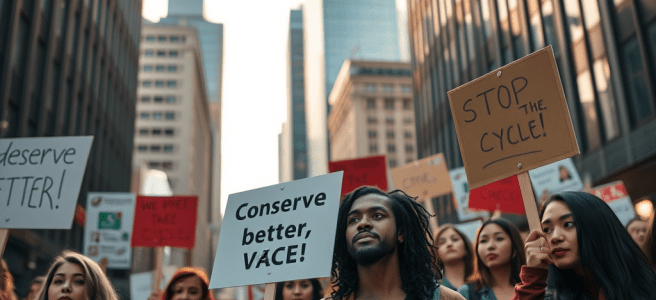
I’m tired of watching big corporations dictate what we buy, how much we spend, and what level of quality we’re “allowed” to expect. We deserve better than this cycle of low‑quality goods, high prices, and “customer service” that feels like a hostage negotiation. And here’s the kicker: consumer spending is still strong, even though people feel worse about the economy and more frustrated with rising prices. Companies know we’ll keep buying, even when we’re unhappy. That’s why nothing changes.
So… What If We Actually Did Something About It? What if we stopped playing along? What if we all, yes, all, decided to stop buying from companies that treat us like walking wallets? What if we went on a coordinated consumer strike? What if we remembered that they are nothing without us? Because that’s the truth. Strip away our purchases, our subscriptions, our clicks, our loyalty, and what’s left? A corporation with no customers. A brand with no audience. A billionaire with no revenue stream. They need us far more than we need them. We Deserve Better. And We Know It. We deserve products that aren’t falling apart. We deserve customer service that doesn’t feel like a chore. We deserve prices that don’t require a small loan. We deserve corporations that respect the people who keep them alive. And the moment we decide to act collectively, really act, they’ll have no choice but to change. So, the real question isn’t whether they’ll listen. It’s whether we’re finally ready to stop whispering our frustration and start using the power we’ve had all along. Who are they without us? Exactly.
Phoenix, my most recently adopted senior pitbull, has always carried herself with quiet strength. Once the queen of the couch and the guardian of the front door, she now spends her nights pacing, her paws tracing invisible circles in the dark. Her eyesight has dimmed to shadows, her hearing fades like whispers in the wind, and arthritis has made her hind legs stiff and sore.
Watching her navigate this stage of life is both heartbreaking and humbling. There are moments when I see her confusion, when she forgets where she is or what she was searching for. And yet, there’s resilience in her steps, a reminder that even in frailty, there is dignity.
I’ve walked this road before with Melita, my fur baby of 19 years, whose final days taught me the bittersweet truth of loving deeply: sometimes, love means letting go. Choosing the day to say goodbye was one of the hardest decisions I’ve ever made. With Phoenix, I carry those lessons forward, balancing care, comfort, and compassion.
Caring for a senior dog like Phoenix means creating an environment that feels safe and familiar. Keeping furniture in consistent places and reducing clutter can help ease confusion when dementia causes disorientation. Establishing gentle routines—regular feeding, walks, and rest—provides comfort and predictability, while small adjustments like soft lighting or calming sounds at night can soothe anxiety during pacing spells. Finally, supporting mobility with ramps, orthopedic bedding, and non-slip rugs, alongside veterinary guidance for pain management, ensures your dog can move with dignity and as little discomfort as possible.
• Create a safe, predictable environment
• Maintain gentle routines with calming nighttime support
• Use mobility aids and consult your vet for comfort
Advice for Owners: Caring for Yourself Too
The emotional toll of caring for a senior dog is real, and it’s important to honor your own well-being alongside theirs. Allow yourself to grieve the small changes as they come, recognizing that each shift in ability is a loss worth acknowledging. Seek out community, whether through friends, support groups, or fellow pet owners, because sharing stories lightens the burden and reminds you that you’re not alone. Most importantly, practice self-compassion: sleepless nights and tough decisions are part of the journey, and remembering that you’re doing your best helps you carry the weight with grace.
• Allow yourself to grieve changes as they happen
• Seek community and connection with others who understand
• Practice self-compassion and remind yourself you’re doing your best
Phoenix’s midnight walks remind me that aging is not a loss of spirit, it’s a transformation. Our senior dogs teach us patience, resilience, and the depth of unconditional love. Caring for them in their twilight years is both a challenge and a gift, one that shapes us as much as it comforts them.
And yet, this journey is not only about them, it’s about us, too. It asks us to stretch our hearts wider, to sit with grief even as we celebrate joy, and to recognize that love is not diminished by endings. In fact, it is magnified. Every sleepless night, every gentle touch, every whispered reassurance becomes part of a legacy of devotion that will outlast their physical presence.
So if you find yourself walking alongside a senior dog, know that you are not alone. There is a community of caretakers who understand the bittersweet beauty of this path. Hold onto the small moments, the wag of a tail, the warmth of fur against your hand, the quiet companionship in the dark. These are the treasures that remain long after the pacing stops, long after the goodbyes are spoken.
Phoenix, like Melita before her, reminds me that love is not measured in years but in presence. And in the end, the greatest gift we can give our dogs, and ourselves, is to honor their journey with compassion, courage, and the knowledge that every step together matters.
Navigating the whirlwind of choosing a college and a major is no small feat. While I didn’t head straight to college after high school, when I finally applied, I found myself uncertain about my future path. My love for reading and writing was undeniable, but the advice from the adults around me was clear: you don’t need a university degree to be a writer.
“Choose something else you like that has benefits and longevity!” So, I decided on Forensic Psychology.
I was 20 when I first stepped foot inside a college classroom. Living on my own in a new state and juggling two jobs (one full-time from 6 am to 3 pm and a part-time from 4 pm to 10 pm) left me with little time to breathe. The long work hours, combined with the heavy course workload, quickly left me feeling overwhelmed and unsatisfied, and craving something more from my experience.
Math was a significant challenge for me, I had to take remedial math three times before I was even able to get into my required math coursework. While my major classes were engaging, I couldn’t shake the recurring question: is this really the career path I want to forever take?
Ultimately, after some honest self-reflection, I decided to quit. I ended up dropping out of school in my junior year.
In the beginning, life was great. I made money and was able to travel a bit, yet every time I returned home to my everyday life, I couldn’t shake the feeling that something was missing. I yearned for a sense of achievement, the fulfillment of pursuing something that truly belonged to me. By this point, I was in my early 30s and had learned a lot about myself. I knew I was a lover of words and stories. I realized that my experiences could be valuable to others if I could find a way to share them. Despite my age and being out of the academic loop for so long, something inside me urged me to give school another try. What would it hurt? But this time, I would focus on writing, no matter how silly people thought I was being. I just wanted to write and become better at it.
When I made the decision to return to school, I anticipated gaining knowledge to support my aspirations as a writer. However, I did not foresee the extensive learning I would encounter, extending far beyond the realm of writing. My education has not only honed my craft but also equipped me with essential skills in self-promotion, marketing, and networking. These valuable lessons have empowered me to navigate the literary world with confidence and creativity.
For example, a social media marketing class (one I was reluctantly taking) inspired me to take a significant step by deleting all my personal social media accounts and replacing them with more professional platforms. This class encouraged me to critically evaluate my objectives as a writer, my target audience, and how to engage with them effectively. Who woulda thunk it!?
Despite this new direction, I often feel out of my depth. As someone who is not particularly tech-savvy and has historically avoided social media, the commitment required to remain relevant on these platforms felt overwhelming. The continuous need to post personal updates seemed unproductive and detracted from my current activities. Nonetheless, through the lens of a professional, a writer, I now understand that engaging with readers through these platforms serves an essential purpose.
Transitioning from personal social media accounts to establishing a professional presence hasn’t been easy, at times, struggling to see how I can “catch up” with my peers.
For instance, I aimed to start with a Bookstagram/BookTube account, using the platforms to push book reviews for my target audience. After researching how book reviews approached this process, I intended to enroll in programs to receive ARC books. Unfortunately, most of these programs require a certain number of followers to be considered, and even meeting this criterion does not guarantee selection.
Of course, there are other important points that I’ve learned ever since my return to school. Here are a few of them listed I no order of importance, because they ALL ARE:
The Power of Consistency: Many writers wish they had understood earlier that writing regularly, even in small amounts, is more effective than waiting for inspiration to strike.
Building a Portfolio is Key: Starting early to create a diverse portfolio of work is essential. This can include short stories, essays, poems, and other forms of writing. A strong portfolio will be invaluable when applying for jobs or graduate programs.
The Importance of Reading and Writing Widely: Reading a diverse range of genres and authors can significantly enhance writing skills and creativity. Exposure to different styles and perspectives broadens a writer’s toolkit. Experimenting with various forms of writing, such as fiction, non-fiction, poetry, and screenwriting, can broaden skills and open up new creative avenues. It also helps in discovering one’s preferred style and genre.
Networking Matters: Building relationships within the writing community can open doors, provide support, and offer valuable feedback. Networking can be as important as the writing itself.
Understanding the Business Side: Knowing the basics of publishing, marketing, and contracts can save a lot of time and frustration. It’s beneficial to learn about the industry early on.
Feedback is Gold: Constructive criticism from trusted sources can be incredibly valuable. Learning to seek and accept feedback early can accelerate improvement.
The significance of peer reviews cannot be underestimated. Throughout my developmental years, any time I shared my writing with those around me, I received positive feedback. In retrospect, it appears that either they were overly generous and most likely feeding me boloney or simply lacked proper critique skills.
In the context of academic peer review, there are established guidelines that must be followed. Feedback is not solely based on personal opinion but also on whether the writing meets specific criteria. During one such peer review of my short story, I received feedback indicating that my use of tenses and verbs was inconsistent throughout the narrative. This critique was not novel to me, and upon reviewing other evaluations, I recognized its validity. This feedback served as a valuable learning experience, and because of it, I decided to pursue a TEFL certification to improve my English skills which now also enables me to teach English as a foreign language.
With hindsight, I realize that if I had pursued formal education in writing from the beginning, I would have acquired substantial knowledge. The potential outcomes of such a path remain speculative. If I could tell my younger self one thing it would be to truly follow what makes you happy. That, if anyone comes around saying “Choose something else you like that has benefits and longevity!” Tell them no. Tell them, that whatever makes your heart happy is beneficial and will last you longer than anything else that’s “reasonable.” And remember that life is not a sprint; it is about the journey, so make it a point to enjoy yours.
In the whimsical dance of life, I’ve found solace in the serendipitous wisdom of self-help books. Rather than a linear journey from cover to cover, I let fate guide my hand to a page that whispers just what my soul needs to hear. On a day kissed by destiny, I cradled “The Art of Possibility” by Rosamund and Benjamin Zander in my hands. It was page 42 that caught my eye, where Rosamund muses on the art of remolding the past:
“How often do we stand convinced of the truth of our early memories, forgetting that they are but assessments made by a child? We can replace the narratives that hold us back by inventing wiser stories free from childish fears, and in doing so disperse long held psychological stumbling blocks.”
This passage is a beacon, illuminating the profound influence of perception and our sovereign right to redraw the contours of our personal tales. The Zanders assert that the fabric of our existence is spun from the yarns we narrate to ourselves and absorb from others. By rethreading these yarns, we possess the alchemy to transform our view of life and the tapestry of our connections.
This resonated with me profoundly, as mere days prior to reading this, I was enveloped in the warmth of my mother and visiting aunts from Colombia. Amidst a symphony of laughter and the spirited flow of aguardiente, confessions and lessons from their lives unfurled like vibrant threads. Each shared their own saga of clandestine escapades, with no remorse for the masquerades necessary to guard their secrets.
As the day unfolded, family lore long concealed began to emerge, like specters stepping out for a promenade. The revelations about my parents soon followed. I discovered truths that had been veiled from my childhood gaze, piecing together the mosaic of my upbringing.
A melancholy tide now washes over me. In those shared moments, I saw my father not as an enigma, but as flesh and blood, flawed and real. The very kin who harbored their own secrets were quick to cast stones at what I once believed was an unblemished fortress of love, my dad. My adoration for my father was unwavering, yet I was led to see him as a beast. He was no beast; he was simply human.
I harbor no rage when I ponder these revelations. Might my bond with my father have flourished differently if his image hadn’t been tarnished by others’ unchecked emotions? If they had shielded me from the complexities, rather than painting him as a villain?
Revisiting the past holds a sacred significance for me now. With the wisdom of adulthood, I perceive life through a lens refined by my own experiences. It’s a curious thing; I once prided myself on being open-minded, and perhaps I was, in some respects. Yet, as I’ve journeyed and adventured, my consciousness has blossomed further.
The anniversary of his departure looms on the horizon. For the first time, I can honor his memory with tears of love, not sorrow. Some might say it’s too late, his absence a barrier. But I disagree. I’ve been graced with the insight and maturity to understand what was once beyond my grasp. This is tranquility, a gift I never anticipated. I cherish this newfound closure and embrace the evolution of our bond.
My journey into the blogosphere was born from a dream to one day become a published author. Yet, the thought of exposing my inner musings to the gaze of the unknown was a daunting barrier. As time unfurled, I grew more comfortable with unveiling my words, largely because the eyes that perused them weren’t those of familiar faces. Still, there are moments when I retreat, ever so slightly. Countless are the instances where I’ve shared a piece of my soul, only to retract it in a dance of hesitation, wary of causing a stir or unsettling the peace.
The transformation I yearn for through my blog is one that originates from within, a personal revolution that’s already in motion. Reflecting on my inaugural post and witnessing the evolution of my craft is both exhilarating and a source of encouragement. It’s in this metamorphosis that I perceive a shift in the cosmos. After all, altering a single soul can set the stars in a new alignment.
Indeed, I harbor hopes that my narratives resonate with someone, somewhere. That through the communion of my tales, readers may find a spark of inspiration, a drive to persevere against their own tribulations. Yet, by dedicating myself to the art of writing with sincerity and benevolence, such connections will naturally form. The metamorphosis I seek for my blog is not just an alteration, but a perpetual, inspiring, and dynamic force within my own realm, sending ripples across the fabric of the Universe.
Finding joy in life often comes from the simplest of rituals; for me, it is the act of nurturing my plants. With each passing year, I find myself dedicating more time to this practice—not because my collection has grown, but because I’ve discovered a profound bond in the process. It’s a bond that breathes vitality into my days.
To me, nature is nothing short of real-life enchantment. When we pause to contemplate the complexities of life, the elaborate dance required to execute even the most “basic” actions, we realize it transcends mere science. Existence is a tapestry of being and becoming. Life burgeons, stretches, and transforms right before our eyes—yet we often overlook the spectacle.
Tending to my plants anchors me in the now. It’s a meditative state where, for a fleeting moment, my personal tribulations fade into the background, and all that remains is the verdant oasis I’m cultivating. In this sanctuary, amidst the foliage and blooms, I find a serene assurance that, in this very instant, everything is as it should be—perfectly okay, perfectly magical.
Choosing to live childfree was a conscious decision for me, one rooted in the desire to navigate life on my own terms. I simply didn’t desire the obligation of nurturing and shaping a young life. My preference was, and continues to be, experiencing life on my own terms. However, what I hadn’t anticipated was that inviting a partner into my life could sometimes echo the challenges of parenthood.
I’ve encountered numerous women with long-term partners or husbands who echo my feelings, indicating it’s a shared experience rather than an aversion to societal duties. It’s as if society has scripted our roles: men jest about choosing the “level of crazy” they can tolerate in women, while women wryly note that all men are akin to children, leaving us to ponder just how much additional “parenting” we’re prepared to extend.
A recent episode with my significant other left me questioning the very essence of our dynamic and if I actually had avoided parenting altogether.
The sting of unheeded counsel is all too familiar which is particularly trying when it comes from a place of professional expertise. With a wealth of knowledge spanning over two decades in my field, I was once the expert he revered, the beacon that guided his career choice. Yet, as time marches on, his ears seem attuned to everyone’s advice but mine.
This pattern reminds me of my own youthful dismissal of my mother’s wisdom, which I once deemed obsolete. Yet, invariably, her insights proved prescient, a lesson I learned through repeated stumbles. Children may outgrow this phase, but adults, like my partner, often remain obstinately resistant.
Witnessing him return home, drained from the day, only to rise embittered and anxious, is disheartening. My attempts to offer proven strategies—real-world solutions that have bolstered similar ventures—are met with indifference. It’s maddening, particularly when his business is still pliable, ripe for innovation.
These moments accumulate, a growing ledger of disillusionment, prompting me to wonder: what role do I truly play here? What is the value of expertise if it remains unheard within one’s own sanctuary? What actual purpose am I serving here?
It’s a quandary that challenges the very core of partnership and mutual growth.










 Natal Galvan
You must be logged in to post a comment.